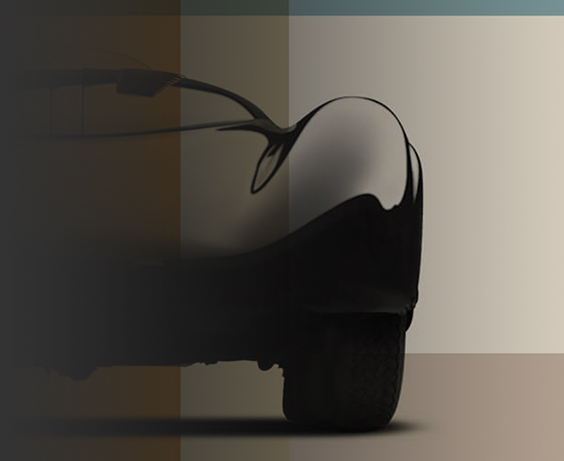





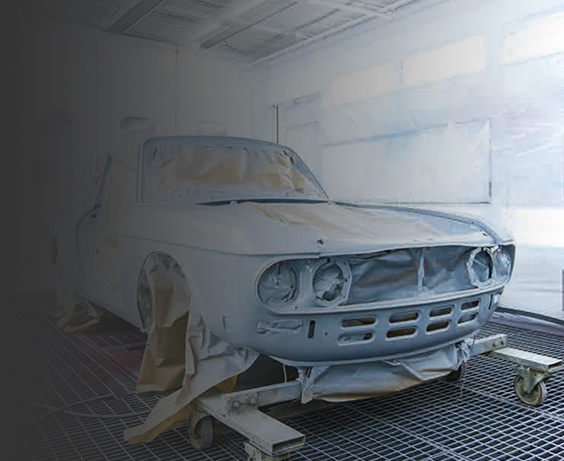

An elegant saloon car in true Lancia style. As it evolved, the Fulvia went from a comfortable four-door family car to the sporty character of the coupé version that would become the forerunner of Lancia's victories in rallying.
Tradition of models in pairs
For many years, Lancia has maintained its tradition of producing two of what could be referred to as “scale models”, one larger than the other but with many components in common. In the last century, there has been one pairing after another: Astura and Artena, Aprilia and Ardea, ahead of the Aurelia and Appia.
Hence the creation of the Lancia Flavia in 1960 to join the more compact Fulvia. As previously, the two cars shared many of their features: part of the chassis, the entire rear axle, but also mechanical parts and components, from the switches on the dashboard to the chrome-plated air vents.
A saloon car for the family
The Fulvia was based on a design by Piero Castagnero as a family saloon to follow in Lancia tradition. A great deal of attention was therefore paid to the quality of the materials, spaciousness and load capacity, characteristics that influenced its lines, to design a four-door with a very wide opening, a bright passenger compartment with slightly inclined windshield and rear window, and a horizontal bonnet and trunk.
Tradition brought up to date
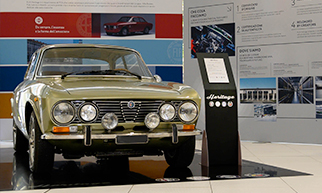
The entire grille was enclosed in an ellipsoid with a chrome-plated profile that included the four headlights of equal size. The typically trapezoidal grille was a stylised reminiscence of the glorious badge featured on the front of many Lancias, past, present and future.


Cavalleria
The original taillights recalled the form of the “Lancia Cavalleria” flag: a round position/stop light in the middle, split into strips moving outwards; the indicators above with a yellow gem; the white reversing light below, also the same size. The cavalleria (‘chivalry’) of Lancia customers – attention to the Highway Code and to other users – was summarised in an illustrated flyer handed out at dealerships.
Lancia customers stand out not only for the elegance of their cars but also for their ‘chivalrous’ driving. On the rear window of all Fulvia models, the sticker of a lance with a yellow staff bearing a blue flag (the colours of Turin) recalled the Lancia Cavalleria: a sign of fairness, manners and respect for other road users.
Space and attention to detail
The spacious passenger compartment had enough room for up to five, with comfortable seats in both the front and rear. The lack of a central tunnel broadened the entire floor even further. The materials and 'courtesy’ solutions were sophisticated, including a switch when the doors were opened that turned on the ceiling light on the same side. The spare wheel in an upright position made the boot both sizeable and practicable.
Cantilevered front
As per the Flavia, the Fulvia also took up the layout held dear by the engineer Antonio Fessia, a professor at the Polytechnic University of Turin as well as Lancia technical director from 1955. He believed that a front-wheel drive architecture with a cantilevered engine was safer and more effective for everyday use. The entire front end was sophisticated from a technical point of view: the mechanics and chassis were mounted on a sturdy subframe, anchored to the body with four elastic supports for comfort. The front suspension was independent with wishbones and hydraulic shock absorbers suspended from a single transverse leaf spring. A rigid axle on leaf springs to support the rear axle lent itself well to considerable loads, with no major changes to the car's set-up.
Narrow V to bring tradition up to date
In the Fulvia, however, the drive unit differed from the Flavia’s boxer engine; it inherited its architecture – if little else – from the Appia: four cylinders in a narrow V at approximately 12°. The engineer Ettore Zaccone Mina selected a layout that adhered to Lancia tradition, yet designed a very modern engine: two chain-driven overhead camshafts, cast-iron cylinder block, with the cylinder head, crankcase, valve cover and oil sump made of aluminium alloy. The unit was tilted 45° to reduce vertical clutter. The initial displacement was 1,091 cc. Despite its compactness, the crankshaft had three main bearings: a solution that would later enable the HF Coupé to withstand the increase in displacement to 1.6 litres and the power to over 160 hp.
The four-speed gearbox with steering wheel control was located in the centre of the symmetry axis, behind the differential and therefore facing the passenger compartment. Disc brakes on all four wheels were not taken for granted in a compact family car at the time; in actual fact, as mentioned above, they were one of the Flavia’s many lasting legacies.


Debut in Geneva and turning point in Turin
Its official launch took place at the 1963 Geneva Motor Show. Unfortunately, the initial models showed up the car's limitations: the engine was not very powerful at under 60 hp, with a kerb weight of over a ton (1,030 kg). Both the relatively modest performance and its high consumption were affected. Lancia ran for cover by changing the jets of the double-barrel carburettor: this was an improvement, but not to a great extent.
The real turning point came at the Turin Motor Show in November the following year. With its two Solex C32 double-barrel carburettors, new intake ducts and increase in compression ratio from 7.8 to 9, the car's power rose to 70 hp and the Fulvia literally changed its identity. Improvements – such as the stronger clutch and certain aesthetic details – accompanied the appearance of the 2C label on the grille. The stated top speed (according to Lancia habit an approximate value by default) was 145 km/h, but the specialist press of the time who tested the car easily reached 150 km/h.
The elegant Coupé
As per the Flavia, the Fulvia was also joined by a coupé version. The design remained in the hands of Piero Castagnero, drawing his inspiration from elegant Riva motorboats. With a shortened wheelbase and the 2+2 passenger compartment, the “Fulvietta” included the new evolution of the compact V4: with its displacement rising to 1,216 cc, again with two double-barrel carburettors, the power gained a further dozen horsepower or so. With the gearbox still at four-speed but with floor control and a long chrome-plated lever, the Fulvia Coupé weighed in at 950 kg and had a top speed of 160 km/h. It made its debut at the 1965 Geneva Motor Show; the same autumn, Zagato took his Sport version with aluminium bodywork to the Turin show.
From 2C to GT…
The natural consequence was the transplantation of the new engine to the saloon as well: hence the creation in spring 1967 of the Lancia Fulvia GT (Gran Turismo). For the first time, an underfloor gearbox was finally available as an optional extra, although it was taken on by most customers. The stated top speed rose to 152 km/h but once again, the models tested by the specialist press reached 160 km/h. As per the 2C, the initials GT appeared after the italics on the rear and in the characteristic blue and gold plate with white characters on the grille. A slight adjustment to the displacement took it to 1,231 cc, although performance remained unchanged.
…later GTE
In late 1968, again following the evolution of the Fulvietta, the 1,298-cc unit of the 87-hp Fulvia Coupé Rally 1.3 resulted in the Fulvia GTE (Gran Turismo Europeo, ‘European grand tourer’). The increase in power took top speed to 161 km/h. The first series ended with the GTE.
Fulvia second series, from 1970
At the 1969 Turin Motor Show, shortly after announcement of the acquisition by Fiat, the second series made its debut. The engine and gearbox remained those of the GTE, with improvements in the electrical components. The wheelbase was slightly increased and the grille changed to a plastic format with no trapezoid and differing diameters for the four headlights. The bumper was protected with rubber and the entire rear was redesigned, with new larger vertical lights reminiscent of the ones in its contemporary, the Flavia.
The interiors were also new, from the dashboard and instrument panel to the steering wheel. About a year later, its five-speed gearbox was inherited from the coupé. Production ended in 1972, at more or less the same time as the Sport Zagato; just under 200,000 units were produced between the two series. On the other hand, the Coupé – thanks above all to Munari and Manucci's unexpected victory at the 1972 Monte Carlo Rally in the legendary notte dei Turini – remained in production until 1976.


From calm saloon to racing car
Starting with the adoption of the two double-barrel carburettors, some Lancia Fulvia 2Cs began to appeal to the newly founded HF Squadra Corse Racing Team, lining up alongside the Flavia Coupé and Sport Zagato. The team was set up in February 1963 by young Cesare Fiorio, son of Alessandro, then Head of Communications at Lancia.
Leo Cella and Sergio Gamerana won the 1965 Rally dei Fiori (later known as the Sanremo Rally from 1967), aboard a Lancia Fulvia 2C entered by the Squadra Corse. With the advent of the Lancia Fulvia Coupé HF, the saloon was no longer officially used in racing, but showed remarkable road holding, especially in conditions of poor grip. It was definitely prone to understeer but was particularly sensitive – in sports driving – to braking with the left foot. A veritable learner car to safely push to the limits the new driving techniques for the emerging front-wheel drive.