





Authentic Alfa Romeo with sophisticated mechanical, chassis and aerodynamic solutions, giving it that sporty character in line with the Biscione brand's tradition. Created with the glorious twin-cam raised to 1.6 litres, later joined by the classic 1300. It became the symbol of Italian sports saloon cars, the basis for the winning Sprint GT and the timeless Spider.
Five-speed 1600
The Giulia T.I. was positioned in the range above the Giulietta. It was a difficult task to design a saloon car that substantially improved on the already outstanding qualities of the Giulietta, from all points of view. The engine saw an increase in displacement, from 1290 cc (1300) to 1570 cc, i.e. 1.6 litres, remaining in a longitudinal front position, with a five-speed gearbox and rear-wheel drive. The chassis was refined: the independent wishbone front suspension was improved with the addition of oblique connecting rods, whereas the longitudinal arms in the rear were made of boxed sheet metal and positioned lower than in the Giulietta, a solution that allowed for a more modern and sleek line.
Aerodynamics
It may seem paradoxical to refer to aerodynamics for a car that now appears so angular, but actually the considerable inclination and lateral curvature of the windscreen, combined with the deep grooves that extended along the entire side up to the truncated tail, favoured the reduction of the impact with the air so much so that the Giulia was advertised with the slogan: “The saloon car traced out by the wind”. It is worth a mention that this was one of the first cars to use the windscreen and rear window as structural elements, to give the car greater torsional rigidity.
Grit and symmetry
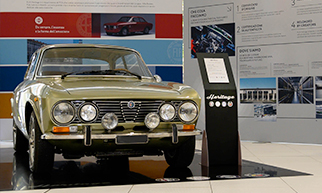
The metal grille with four headlights, the two smaller interiors, the classic Alfa Romeo badge in the middle and its chrome bumpers with vertical guards all showed its grit. Its hallmarks included symmetrical windscreen wipers that traced arcs from the middle to the outer edge of the glazing, as well as the boot with its recess in the central part of the cover and the deep edging of the vertical section that retracted to close the truncated tail.
Rear seats for three
The passenger compartment was large and spacious: both the front and rear seats were given two benches, plus thanks to the gearbox on the steering wheel, the Giulia was approved for six people: three in front and three in the back. There was plenty of space in the angular boot, whereas the braking system had four drum brakes with three self-centring shoes in the front: a solution as sophisticated as it was rare.
Debut at Monza, 1962
The official launch at the Monza racetrack on 27 June 1962 aimed to highlight the sporty profile of the new Alfa Romeo saloon car. Initially produced on the lines of the glorious Portello plant, it would soon go into production at Arese, as its inauguration approached. One of the anecdotes told at the presentation on the Monza circuit resulted in an unwitting leak that went unnoticed by many journalists: the gearbox – with its lever on the steering wheel as per tradition at the time – also came with a fifth gear.


Turismo Internazionale
The 1,570-cc twin-cam was equipped with a special vertical double-barrel carburettor that included a vacuum system to open the second body only when more load was required. It delivered 90 hp and generated an exciting roar, whereas the five-speed gearbox made the most of the excellent thrust from low revs. The initial version was named Alfa Romeo Giulia T.I. (Turismo Internazionale), an early nod to its use on the track the same way as the “Giulietta t.i.”, which served as the debut car for a generation of drivers, including Jochen Rindt, F1 World Champion in 1970.
The legendary T.I. Super
Not even a year later, once again on the Monza circuit, a more than souped-up version was launched: the Alfa Romeo Giulia T.I. Super. In common with the Giulia SS – heir to the Giulietta SS (Sprint Speciale) – the engine had two 45 Weber double-barrel carburettors, delivering 113 hp. The gearbox had a yoke control and split seats but above all it weighed 100 kg less: its improved lightness and much more powerful engine took its top speed from 169 to 189 km/h. From September 1963, first as an optional extra and then as standard, four disc brakes were fitted to replace the drums, in an operation that was replicated across the Giulia range.


Quadrifoglio
Produced in only 505 units (509 chassis numbers, one re-marked, three never produced), from 1963 to 1964 the Giulia T.I. Super was recognisable by its green four-leaf clovers. Like sportier Alfa Romeos, it came in a white livery (apart from three cars in graphite grey and two in Police grey-green), with no bumper guards and above all with the two central headlights replaced by metal grilles, rounded like the headlights. These served to increase the flow of air into the engine compartment, for both intake and overall cooling.
Arrival of the Giulia 1300
Alfa management believed that the glorious 1300 twin-cam Giulietta t.i. could expand the offering by bringing in list prices and operational costs slightly lower than for the mass-six. Produced until 1967, the first version of the Giulia 1300 with 80 hp and a four-speed gearbox introduced the grille with only two headlights and no bumper guards.
Gold stickers
In 1965 came the first major update, after the comet of the T.I. Super racing car. The Giulia 1600 Super was launched at the Geneva Motor Show, to join the first 1600 T.I. saloon. More elegant inside and out, it offered a little more chrome plating, more protruding rear lights, a more refined interior, a new dashboard with circular instruments, a yoke-only gearbox, split seats in the front, shaped at the back. The four disc brakes were now controlled by brake boosters. Also under the bonnet, the twin-cam was fitted with two double-40-barrel carburettors, delivering 98 hp at 175 km/h. Made until 1967, this model was recognisable for its badge on the larger grille divided into two sections with the upper one built into the bonnet, as well as by the presence of two small gold-coloured stickers on the rear pillars: two round emblems with the cross of Milan and the Biscione serpent.
Higher horsepower for the 1300
The transplantation of the Giulietta's mechanics was a little too mortifying; in February 1966, the 1300 T.I. version arrived to join the original version with an extra five horsepower (85 hp), alongside a five-speed gearbox, for improved performance with the sales to go with it. At the same time, the 1600 T.I. – still available as was the 1600 Super – kept horizontal instrumentation to follow the Super with its circular instruments.


A full range
From 1967 to '68, the range was essentially split between the Giulia 1300, 1300 T.I. and 1600 Super. In the latter, the badge was placed entirely on the grille and the Biscione emblem on the rear pillar instead of the gold sticker. A difference remained in the headlights: two on the 1300 and four on the 1600, whereas the grilles had only three chrome strips in the first and five in the second with the black grille behind them. The cars’ output was unchanged.
The New Super
With minimal changes in terms of updates to the interior and price lists more so than the mechanics, the 80-hp 1300 exited the stage, the Super 1600's output was raised to 104 hp but the 98 engine remained for the Giulia 1600 S and stayed that way until 1970, when only the Super 1300 (88 hp) and Super 1600 (104 hp) remained.
In April 1972, Alfa Romeo unified the aesthetics of these two models, with the four-light grille also seen in the 1300.
But the genuine restyling took place in 1974 when Alfa introduced the “New Super”, again with both engines and a flat boot, a grille with a black plastic base and a broader badge. It remained in production until 1978; two years earlier, the range was added to by the arrival of the “New Super Diesel”. Fitted with a “Perkins” diesel engine designed for commercial vehicles, it had very low fuel consumption but modest performance.

1750, 2000, GT & Spider
The history of the Alfa Romeo Giulia began in 1962, ended 16 years later after development into a whole series of successful models: 1968's 1750 sedan was followed in 1971 by the 2000, an elegant, larger and more luxurious flagship that used the advanced mechanics on the winning Bertone-designed Sprint GT coupé versions. The Giulia GT dominated the world racing landscape: from the Giulia Sprint GTA and GTA 1300 Junior to their evolutions in the 1750 GT Am, in which the displacement increased to two litres. Pushed not quite as far but with just as much of a power-up, first to 1750 then 2000, were also the engines of the open-top versions, which saw even more longevity than the saloon cars and coupés: in the Alfa Romeo Spider designed by Pininfarina and made from 1966, to the 1990 fourth series of the legendary “Duetto”, produced until 1993.
The T.I. Super in racing
Before the total dominance of the GTAs that began after 1965, Alfa Romeo distinguished itself with the Giulia T.I. Super in track competitions in the European Touring Car Championship, but also in rallies and hill-climb races. Power, agility and endurance amazed not only the insiders when it took part in the gruelling 1963 Tour de France Automobile, where it won the GT 2000 Class, having been entered in the higher category because it had not yet obtained Touring Car type approval; it took fifth place overall with France’s Masoero and Maurin at the wheel.
Leading the way in uniform
The Giulia is the most famous Alfa Romeo in use in the Italian armed forces. The Carabinieri and Police have called upon the Giulia’s remarkable performance for many years, with its large boot suiting the requirements of the patrols that have guarded Italy's cities and streets for two decades. Memorable chases were documented in the 1970s films that recounted an Italy of turbulence, where the police battled violence and crime assisted by the powerful Alfa Romeo Giulia.
